


Related Technologies
Azure OpenAI
Microsoft Purview
MCP Agent Protocol
Azure Model Service
Azure AI Foundry
Microsoft Graph
Azure Data
OneLake
Related Technologies
Microsoft 365
Microsoft 365 Teams and Teams Phone
Microsoft 365 Mobility and Security
Microsoft Azure
Microsoft Entra ID
Microsoft Security
Related Technologies
NovaFlow BPM Engine
Microsoft Dynamics 365 Business Central
Microsoft Dynamics 365 CRM
Microsoft Power Apps
Microsoft Power Automate
Microsoft Power BI
Related technologies
NovaTech Service Center
NovaTech Support Team
ITIL Maintenance Tools
Contact us
Support Hotline:400-902-9162
Company phone:021-22065380
Shanghai Office: Room 1506, Yuexiu Building, No. 388 Fushan Road, Pudong, Shanghai
Suzhou Office: Room 301, Yuanyuzhou Industrial Application Center, Yushan Town, Kunshan
Follow NovaTech

Starting from Business and Practice: Experiencing Copilot’s Value Together with Customers
Events/Sharing Sessions
Starting from Business and Practice: Experiencing Copilot’s Value Together with Customers
OnSeptember15,2026,thesecondMicrosoftCopilotEnterpriseAIEmpowermentWorkshopconcludedsuccessfully.Overthefour-hoursession,hands-onpracticeaccountedfor60%ofthecurriculum.Participantsworkedthroughfourpro...
2026.09.17
NovaTech Keeps Pace with Microsoft’s New Trends Unveiled at Build 2026 to Accelerate Enterprises’ Adoption of Microsoft Full-Stack AI Ecosystem
NovaTech Keeps Pace with Microsoft’s New Trends Unveiled at Build 2026 to Accelerate Enterprises’ Adoption of Microsoft Full-Stack AI Ecosystem
05
2026-06-05
Held at Fort Mason Center in San Francisco on June 2–3 US time, Microsoft Build 2026 Developer Conference showcased Microsoft’s end-to-end closed-loop AI ecosystem spanning self-developed foundational models, system platforms, cloud services, end-user hardware, developer tooling and security governance. The tech giant formally marked the industry’s shift from the Copilot-augmented era to the Autopilot intelligent agent era.
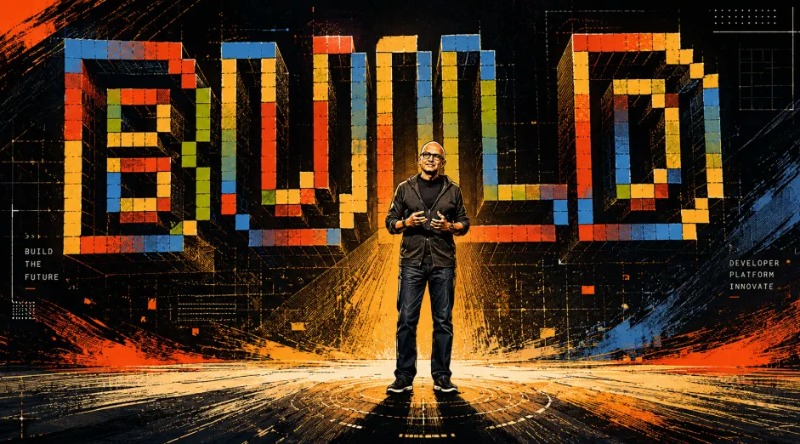
Microsoft rolled out over 20 landmark AI updates at the event, grouped into six core categories:
- MAI Self-developed Model Portfolio: Seven ground-up, non-distilled proprietary AI models were unveiled, covering reasoning, coding, image generation and speech capabilities, enabling Microsoft to fully cut reliance on third-party AI models.
- Autopilot Intelligent Agents: Microsoft Scout, the first always-on personal intelligent agent, and standalone desktop GitHub Copilot App debuted, evolving AI from reactive assistants to proactive collaborators.
- Windows-native Agent Infrastructure: Windows Agent Runtime and MXC system-level AI security sandbox launched, elevating intelligent agents to first-class citizens within the Windows operating system.
- Azure Agent Cloud Offerings: Azure Agent Service went live as a managed hosting platform alongside Agent-optimized VMs delivering a 40x performance boost, compatible with frameworks including OpenAI and AutoGen.
- Revamped Developer Toolchain: Copilot Studio was restructured into an enterprise-grade full-spectrum agent builder, complemented by Rayfin backend development toolkit and ASSERT agent security testing framework.
- AI-Accelerated Hardware: Microsoft introduced Surface Laptop Ultra workstation and Surface RTX Spark Dev Box, alongside Project Solara, a next-gen intelligent agent hardware platform co-developed with NVIDIA.
Jensen Huang, Founder and CEO of NVIDIA, joined the event remotely and commented: “AI infrastructure has entered the agent age, and Microsoft and NVIDIA are co-defining the next generation of AI computing architecture.”
The core takeaway from this year’s Build lies in Microsoft’s fully integrated closed-loop AI ecosystem, built layer by layer from underlying foundational models to upper-tier applications, cloud infrastructure, terminal hardware, development tools and compliance governance, forming an irreplicable competitive moat.
Mustafa Suleyman, head of Microsoft’s AI division, emphasized at the conference: “All MAI models are trained from scratch with original proprietary datasets without incorporating data derived from any third-party models.”
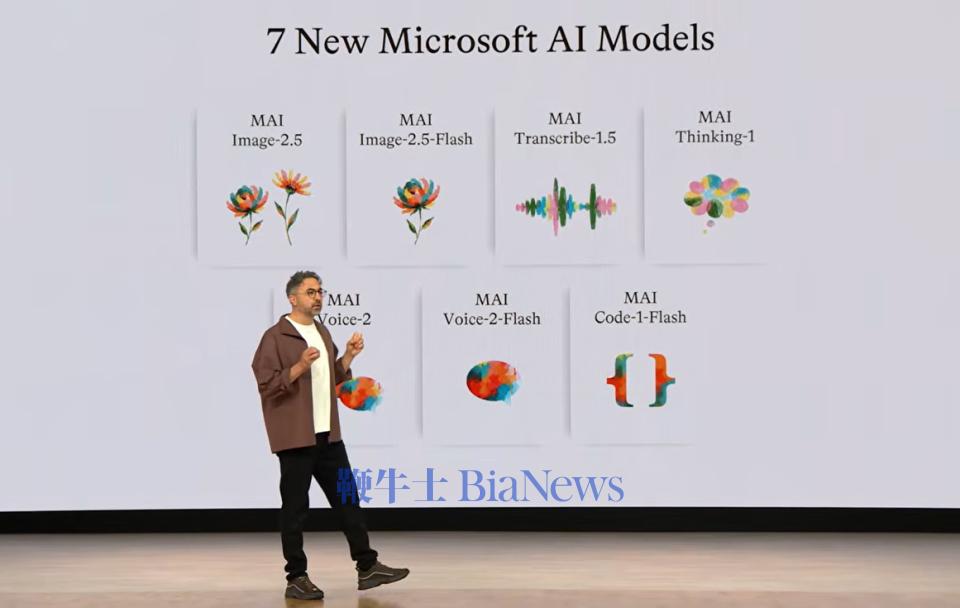
The seven MAI models cover all core enterprise AI scenarios:
MAI-Thinking-1: Flagship reasoning model with 35 billion active parameters, optimized for complex multi-step logical reasoning and decision-making;
MAI-Code-1/Flash: Code-specialized variants natively integrated with GitHub Copilot and VS Code;
MAI-Image-2.5/Flash: Copyright-compliant generative AI for image creation and post-production editing;
MAI-Speech Series: Real-time multilingual speech transcription and natural voice synthesis models;
Aion-1.0-Instruct: Lightweight edge AI model supporting local execution of large-parameter workloads.
The rollout of the MAI lineup transforms Microsoft from a third-party model distributor into a full-fledged in-house AI model developer.
Microsoft officially premiered Microsoft IQ Context Engine, the core backbone of its agent ecosystem. The engine unifies global general knowledge and proprietary enterprise data, mapping workflows across Microsoft 365, internal business systems and external resources including contacts, emails, documents and meetings as well as their interconnections.
Satya Nadella noted: “As AI models become ubiquitous, an organization’s competitive edge no longer hinges on access to AI intelligence, but ownership of customized intelligence. The ability to convert proprietary expertise, enterprise data and business workflows into self-evolving systems that drive tangible outcomes is the defining competitive advantage.”
Traditional Copilot operates as a reactive assistant executing user commands upon request; by contrast, the newly launched Microsoft Scout built on the open-source OpenClaw framework runs persistently in the background as a proactive collaborator. It autonomously sorts emails, schedules meetings, tracks project milestones, compiles work reports and even initiates cross-agent communication on users’ behalf.
Meanwhile, the standalone desktop GitHub Copilot App has officially launched, upgrading from a pair-programming assistant to an equal-tier developer capable of independently completing full-cycle development ranging from project scaffolding and coding to testing and production deployment.
A landmark announcement from Nadella positioned intelligent agents as first-class native Windows components. The newly released Windows Agent Runtime delivers unified resource scheduling and management, empowering developers to build persistent cross-app and cross-device agent experiences.
In addition, Microsoft Execution Containers (MXC), a system-grade AI security sandbox, isolates agent runtime environments to block unauthorized system access and resolve core security obstacles restricting large-scale enterprise agent adoption.
In addition, Microsoft Execution Containers (MXC), a system-grade AI security sandbox, isolates agent runtime environments to block unauthorized system access and resolve core security obstacles restricting large-scale enterprise agent adoption.
Azure Agent Service delivers a fully managed platform for agent deployment, scaling and real-time monitoring, supporting OpenAI Assistants API, AutoGen, LangChain and Microsoft’s proprietary AML development language.
Equipped with NVIDIA Thor GPUs and AMD MI400x processors, Agent-optimized VMs deliver a 40-fold uplift in agent operating performance. Microsoft also revamped Azure’s internal traffic routing via the MRC network architecture and built cross-region dedicated AI networks to underpin next-era agent computing demands.
Equipped with NVIDIA Thor GPUs and AMD MI400x processors, Agent-optimized VMs deliver a 40-fold uplift in agent operating performance. Microsoft also revamped Azure’s internal traffic routing via the MRC network architecture and built cross-region dedicated AI networks to underpin next-era agent computing demands.
Two flagship AI-focused hardware products were unveiled:
Surface Laptop Ultra: Premium Windows AI workstation powered by NVIDIA chips with up to 128GB unified memory for local large-model deployment;
Surface RTX Spark Dev Box: Compact local AI development hardware with 1 petaFLOPS of dedicated AI compute, capable of running 120B-parameter models locally, slated for release in Fall 2026.
Furthermore, Project Solara, co-developed with NVIDIA, serves as a unified cross-device framework enabling seamless task migration of a single intelligent agent across diverse terminals.
Recognizing robust governance as a prerequisite for enterprise AI commercialization, Microsoft launched three core governance solutions:
ACS (Agent Control Service): Enterprise agent governance platform featuring access permission management, audit logging and compliance reporting;
ASSERT: Automated agent security testing suite identifying system vulnerabilities, privacy breaches and ethical compliance risks;
Windows Agent Store: Dedicated marketplace with an 85/15 revenue split for developers and built-in enterprise review & bulk deployment controls.
Microsoft has fully laid out end-to-end infrastructure for the upcoming agent-driven industrial transformation.
As a Microsoft Gold-Certified Partner,NovaTech keeps aligned with Microsoft’s overarching AI strategy. Drawing on over a decade of professional experience serving the Microsoft ecosystem, the firm provides end-to-end enterprise services covering technical consulting, customized solution design and on-site implementation, helping businesses seamlessly migrate from Copilot-powered auxiliary workflows to Autopilot intelligent agent architecture and capture growth opportunities amid the intelligent agent revolution.

